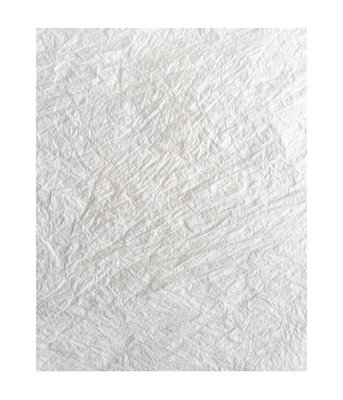
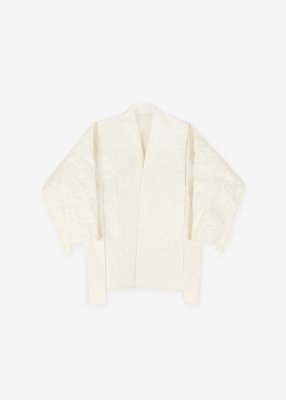
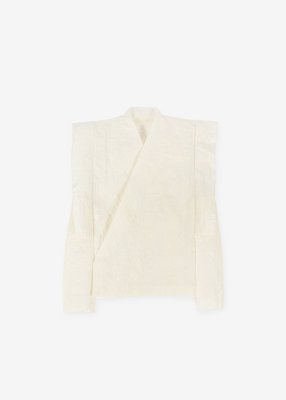
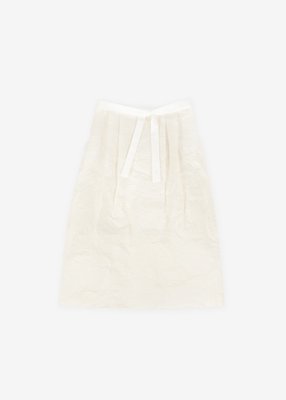
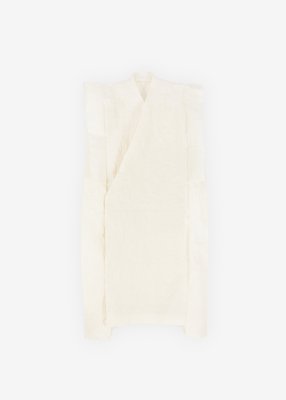
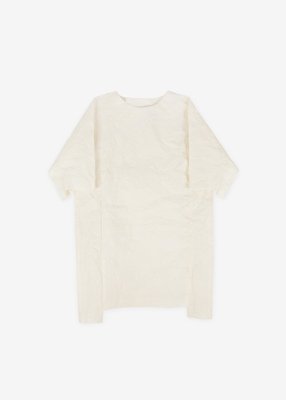
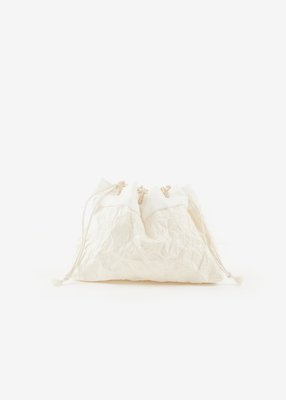
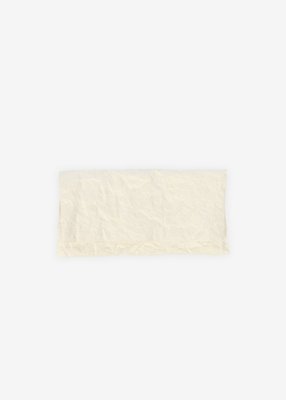
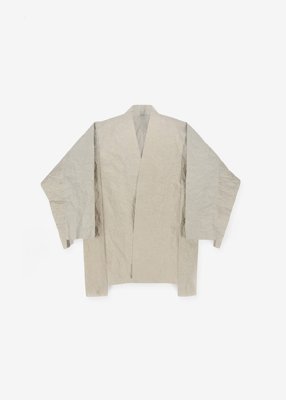
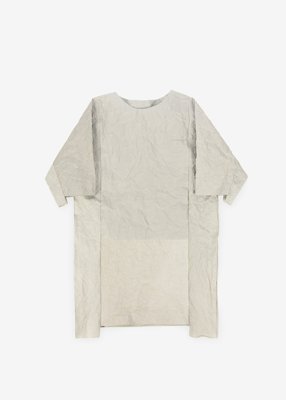
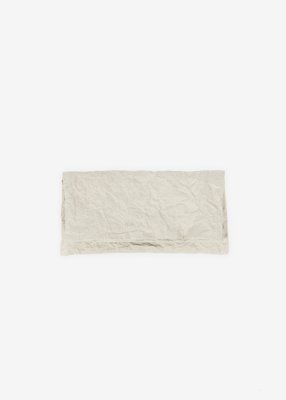
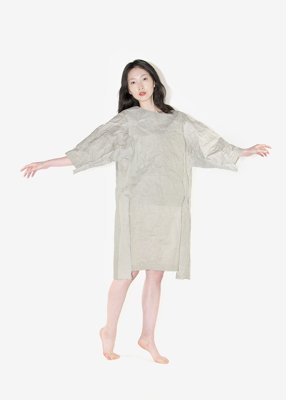
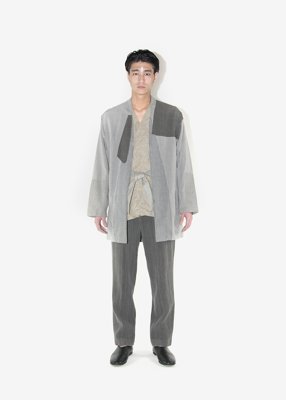
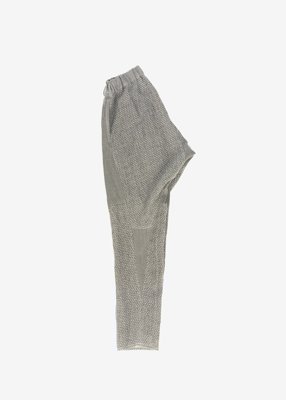
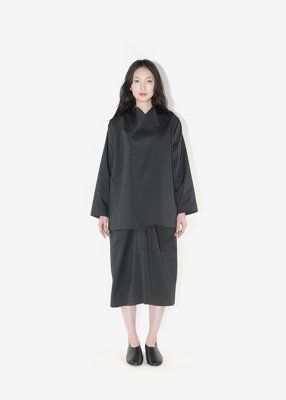
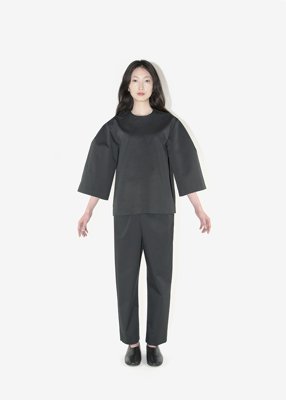
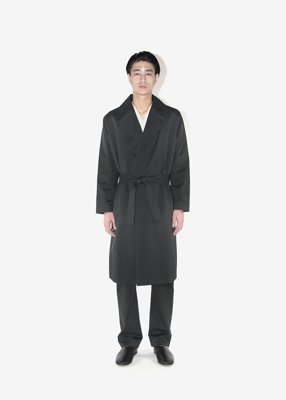
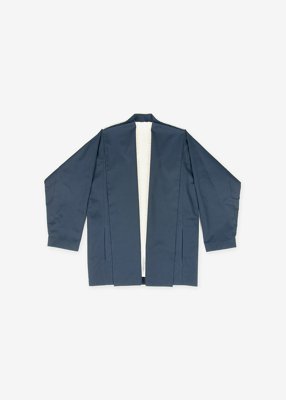
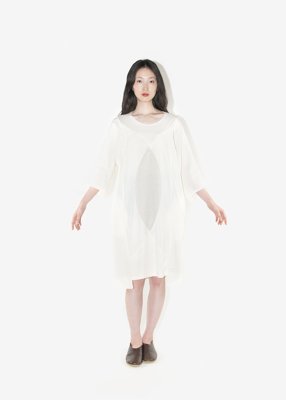
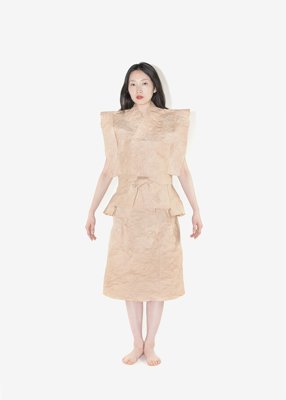
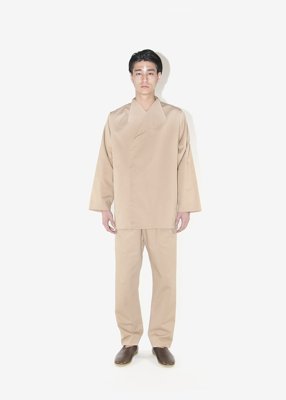
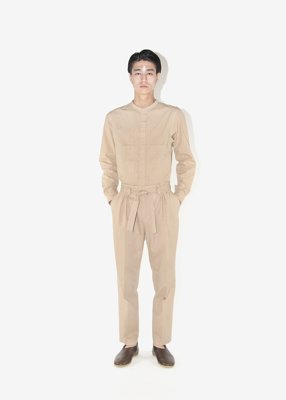
01. Kamikoromo haoriKamikoromo are paper robes made of handmade washi paper. Today, kozo, mitsumata and gampi are the principal raw materials for washi. Kozo is prized for its long, tough fibers. Konjac paste is added for strength and the paper is sewn with hemp yarn and cotton yarn. Like kimono, kamikoromo are constructed with a simple composition of shapes.02. Kamikoromo kimono blouseCosmic Wonder's kamikoromo get their white color from the kozo plant. Kozo is cut at the root and steamed in a barrel over a fire in order to separate the bark. The bundles of fibers are placed in a cold stream for one to three days. The branches are boiled and stripped of their outer bark and then dried. The fibers are then boiled, placed in running water, and naturally bleached. The rinsed fibers are placed in a strainer floating in water for further cleaning and then laid on a board and beaten. Once they have dried overnight and have been softened by stamping or hand-rubbing, they are ready to be made into washi.03. Kamikoromo skirtPaper has long been celebrated in Japanese life for the important role it plays in many rituals, ceremonies, and countless everyday activities. In ancient times, Buddhist priests pasted together paper scraps to make kimonos. This tradition lives on in the form of kamikoromo and in the ceremony called 'omizutori', which is performed at the Todaiji Buddhist temple in Nara. Ippen Shonin (St.Ippen) traveled throughout Japan wearing kamikoromo.04. Kamikoromo kimono dressFrom the Muromachi period onward, kamikoromo spread out through the samurai culture. The one worn by Kenshin Uesugi (one of the most powerful lords of the Sengoku period) is thought to be the oldest surviving kamikoromo. Toyotomi Hideyoshi (a preeminent daimyo) owned a kamikoromo haori (the reverse side was dyed with kobai). By the middle of the Edo period, the use of these paper robes had expanded to the general population. This is the time of Basho, the greatest haiku poet and a wearer of kamikoromo.05. Kamikoromo dressTheir lightness and heat-retaining quality made them popular among travelers and traveling haiku poets. Kamikoromo embody the sense of wabi-sabi, emphasizing the rustic beauty of nature. In the present day, techniques for the production of traditional paper clothing are still practiced in Shiroishi, Miyagi Prefecture.06. Kamikoromo gassai-bukuro bagComposed of handmade washi Japanese paper and hand-loomed choma fabric.07. Kamikoromo clutch bagPaper can be traced back as early as 3000 B.C., in the form of Egyptian papyrus. An early form of paper also came into use in China during the Han dynasty, circa 200 BC. Hemp and choma (ramie) were the raw materials for paper making at that time.08. Kamikoromo small pouchIt is believed that these methods of producing paper were introduced to Japan by Doncho, a monk from Goguryeo, but there are also accounts of these methods developing independently in Japan. Paper production in Japan emerged in the eighth century in places like Mimasaka, Izumo, Mino and Echizen.09. Kamikoromo haori - wildflower herbal dyeKamikoromo are paper robes made of handmade washi paper. Cosmic Wonder's Kamikoromo get their natural gray from a wildflower herbal dye.10. Kamikoromo kimono vest - wildflower herbal dyeToday, kozo, mitsumata and gampi are the principal raw materials for washi. Kozo is prized for its long, tough fibers. Kozo is cut at the root and steamed in a barrel over a fire in order to separate the bark. The bundles of fibers are placed in a cold stream for one to three days. The branches are boiled and stripped of their outer bark and then dried. The fibers are then boiled, placed in running water, and naturally bleached. The rinsed fibers are placed in a strainer floating in water for further cleaning and then laid on a board and beaten. Once they have dried overnight and have been softened by stamping or hand-rubbing, they are ready to be made into washi.11. Kamikoromo skirt - wildflower herbal dyeSticky and strong paper is required to construct kamikoromo. Konjac paste is added for strength and the paper is sewn with hemp yarn and cotton yarn. Like kimono, kamikoromo are constructed with a simple composition of shapes.12. Kamikoromo dress - wildflower herbal dye13. Kamikoromo clutch bag - wildflower herbal dye14. Kamikoromo dress - wildflower herbal dyeThe wild materials are transformed into fine washi paper.15. Bingo-kasuri jacket and slacks - sumikuroBingo-kasuri cotton produced by a traditional textile manufacturer in Japan. Woven slowly with an antique shuttle weaving machine. This method of weaving allows air to get inside the cotton during the weaving process.16. Bingo-kasuri dress - sumikuroComposed of several varieties of Bingo-kasuri fabric and herbal dyed pure wool. Sashiko and hand-embroidered patchwork.17. Bingo-kasuri kimono blouse and striped slacks - sumikuroThe color comes from Japanese sumi-ink. Sumi color is produced by combining sumi-ink and wood vinegar. Many cycles of washing before drying under sunlight. Dyed yarns are woven slowly with an antique shuttle weaving machine.18. Washi and Bingo-kasuri cap - sumikuroComposed of handmade washi paper and Bingo-kasuri fabric. The color of washi comes from a persimmon tannin dye.19. Mountain wool knit geometric pattern sweaterKnit sweater made from sheep's pure wool from the mountainous regions of Peru. They have been a valued part of this natural environment since the days of the ancient Incas. Sheep's wool from high in the mountains provides excellent ventilation and heat-retaining properties.20. Japanese natural stone necklace with hemp cordA quartz crystal from Oita Prefecture, Japan.21. Organic cotton day dressDesigned with a comfortable shape for daily activities.22. Rolled-up sleeved pullover and wrapped pantsMade from organic cotton broad cloth fabric. Constructed with a minimal composition of planes.23. Geometric patterned dress - bengalaDress composed of organic cotton single jersey and finest linen-wool fabric. The linen-wool part is composed of plain-woven fabric and twilled fabric. The color comes from bengala herbal dye.24. Geometric patterned pullover and organic cotton broad cloth wrapped pants - bengala25. Colored denim haori and jeans - bengalaColored denim haori jacket and five-pocket denim pants with a 'Flower-of-life' gold-colored button and patchworks on pockets. Made from organic cotton drill fabric. The gray color is from bengala herbal dye.26. Edo-komon coat dressAn Edo-komon print reproduced from an original sample book of the later Edo-period. Made of dual-layered organic linen-wool fabric and the finest twilled linen-wool fabric. Different Edo-komon are printed on each fabric with Japanese ink on raw linen.27. Edo-komon kimono dressThe fabric is produced by a historic textile manufacturer in Oumi-koto, an area known for its hempen cloth textiles.28. Edo-komon pantsMade of dual-layered organic linen-wool fabric and the finest twilled linen-wool fabric. Constructed with a minimal composition of planes.29. Twill-weave organic cotton jacket coat and wrapped skirtSoft surface texture of organic cotton. Pure woolen boa lining for the coat.30. Twill-weave organic cotton blouse and wrapped pants31. Twill-weave organic cotton trench coat and slacksConstructed with a minimal composition of planes.32. Twill-weave organic cotton trench coatPure woolen boa and linen cloth lining.33. Edo-komon knit stoleAn Edo-komon patterned knitting reproduced from an original sample book of the later Edo-period. Composed of organic cotton yarn and the finest wool yarn. The color comes from a logwood herbal dye.34. Japanese natural stone necklace with hemp cordA topaz from Shiga Prefecture, Japan.35. Alpaca woolen knit dressPure 100% alpaca. Pure alpaca's wool have excellent ventilation and heat-retaining properties. The hem is composed of ribbed kitting and seamless knitting.36. Herbal dyed pure woolen dress with hemp braided cord beltMade of 100% pure sheep's light melton. The color comes from a logwood herbal dye. The belt is made from natural hemp thread. Braided in a Japanese traditional braiding technique called karauchi.37. Herbal dyed pure woolen coat, herbal dyed folk linen blouse and wrapped pantsComposed of 100% pure sheep's light melton and linen. The color comes from a logwood herbal dye.38. Herbal dyed pure woolen jacket, work pants and organic cotton white shirtMade of herbal dyed 100% pure sheep's light melton wool. The color comes from a logwood herbal dye. Layered linen lining retains warmth. The organic cotton broad cloth white shirt is produced by earth-friendly, non-chlorinated water bleaching.39. Colored denim haori and jeansMade from organic cotton drill fabric. Colored denim haori jacket and five-pocket denim pants with a 'Flower-of-life' gold-colored button and patchworks on pockets. White color is produced by earth-friendly, non-chlorinated water bleaching.40. Kamikoromo kimono blouse and skirt - indigoCosmic Wonder's Kamikoromo. The deep blue color comes from a natural indigo herbal dye. Kamikoromo are paper robes made of handmade washi paper. Today, kozo, mitsumata and gampi are the principal raw materials for washi. Kozo is prized for its long, tough fibers.41-1. Bingo-kasuri jacket and slacks - indigoBingo-kasuri cotton produced by a traditional textile manufacturer in Japan. Woven slowly with an antique shuttle weaving machine. This method of weaving allows air to get inside the cotton during the weaving process.41-2. Bingo-kasuri jacket - indigoComposed of several varieties of indigo dyed Bingo-kasuri fabric. Sashiko and hand-embroidered patchwork.42. Washi and Bingo-kasuri cap - indigoComposed of handmade washi paper and Bingo-kasuri fabric. The color of washi comes from a persimmon tannin dye.43. Bingo-kasuri blouse and skirt - indigoComposed of several varieties of Bingo-kasuri fabric. Many cycles of washing before drying under sunlight. Sashiko and hand-embroidered patchwork.44. Bingo-kasuri Kimono dress - indigo45. Twill-weave organic cotton trench coat and slacksSoft surface texture of organic cotton. Pure woolen boa lining for the coat.46. Twill-weave organic cotton dress with hemp braided cord beltDress constructed with a minimal composition of planes. The belt is made from natural hemp thread. Braided in a Japanese traditional braiding technique called karauchi.47. Twill-weave organic cotton jacket coatOrganic cotton for the outer fabric. Pure woolen boa and linen cloth lining.48. Herbal dyed pure woolen coat jacket and skirtMade of 100% pure sheep's light melton. The color comes from a logwood herbal dye. Layered linen lining retains warmth.49. Herbal dyed pure woolen coat, work pants and organic cotton sweatshirtMade of 100% pure sheep's light melton jacket and work pants. The color comes from a logwood herbal dye. The sweat shirt is made from organic cotton flannel fleece lined sweat fabric.50. Herbal dyed folk linen blouse and woolen wrapped pantsComposed of linen and 100% pure sheep's light melton. The color comes from a logwood herbal dye.51. Selvedge denim indigo Haori jacket and jeansIndigo denim made from organic cotton 13oz selvedge denim. Haori denim jacket and five-pocket denim pants with a 'Flower-of-life' gold-colored button and patchworks on pockets.52. Organic cotton wrapped dress - Ryukyu indigoComfortable organic cotton dress. Wearable in various ways. The deep oceanic Ryukyu indigo blue is produced with many application of dye by a skilled dyer.53. Geometric patterned pullover and organic cotton broad cloth wrapped pants - Ryukyu indigo54. Geometric patterned dress - Ryukyu indigoDress composed of organic cotton single jersey and finest linen-wool fabric. The linen-wool part is composed of plain-woven fabric and twilled fabric. The color comes from Ryukyu indigo.55. Japanese natural stone necklace with hemp cordA quartz crystal from Yamanashi Prefecture, Japan.56. Natural hemp cord beltBraided in a Japanese traditional braiding technique called karauchi.57. Mountain wool knit cardiganKnit cardigan made from sheep's pure wool from the mountainous regions of Peru. They have been a valued part of this natural environment since the days of the ancient Incas. Sheep's wool from high in the mountains provides excellent ventilation and heat-retaining properties.58. Mountain wool knit pantsKnit pants made from alpaca's pure wool from the mountainous regions of Peru. Natural colors of alpaca. Colors are sorted by hand in the local tradition.59. Geometric patterned dressDress composed of organic cotton single jersey and finest linen-wool fabric. The linen-wool part is composed of plain-woven fabric and twilled fabric.60. Kamikoromo kimono blouse and skirtCosmic Wonder's Kamikoromo. The color comes from a persimmon tannin dye. Kamikoromo are paper robes made of handmade washi paper. Today, kozo, mitsumata and gampi are the principal raw materials for washi. Kozo is prized for its long, tough fibers. Kozo is cut at the root and steamed in a barrel over a fire in order to separate the bark. The bundles of fibers are placed in a cold stream for one to three days. The branches are boiled and stripped of their outer bark and then dried. The fibers are then boiled, placed in running water, and naturally bleached. The rinsed fibers are placed in a strainer floating in water for further cleaning and then laid on a board and beaten. Once they have dried overnight and have been softened by stamping or hand-rubbing, they are ready to be made into washi.61. Twill-weave organic cotton jacket coat and slacksSoft surface texture of organic cotton. Pure woolen boa lining for the coat.62. Organic cotton broad cloth fly front dress shirt and twill-weave organic cotton slacks63. Twill-weave organic cotton trench coat and naturally tanned leather shoesVegetable tanned smooth textured leather. No hazardous chemicals, artificial coloring or treatments are used throughout the production process. This leather gradually gains its own unique color as time passes. Clean hue with concealed stitching.64. Herbal dyed pure woolen work pants and organic cotton sweatshirt100% pure sheep's light melton woolen work pants. The color comes from an areca catechu herbal dye. The sweat shirt is made from organic cotton flannel fleece lined sweat fabric.65. Organic cotton flannel sweat dress with hemp braided cord beltMade from organic cotton flannel fleece lined sweat fabric in beige. The belt is made from natural hemp thread. Braided in a Japanese traditional braiding technique called karauchi.66. Herbal dyed folk linen blouse, skirt and herbal dyed woolen coatComposed of linen and 100% pure sheep's light melton. The color comes from an areca catechu herbal dye.67. Kamikoromo kimono vest - Akane herbal dyeCosmic Wonder's Kamikoromo. The ume flower color comes from an Akane herbal dye. Kamikoromo are paper robes made of handmade washi paper.68. Kamikoromo skirt - Akane herbal dye69. Kamikoromo blouse - Akane herbal dyeSticky and strong paper is required to construct kamikoromo. Konjac paste is added for strength and the paper is sewn with hemp yarn and cotton yarn. Like kimono, kamikoromo are constructed with a simple composition of shapes.70. Kamikoromo Kimono dress - Akane herbal dyePaper can be traced back as early as 3000 B.C., in the form of Egyptian papyrus. An early form of paper also came into use in China during the Han dynasty, circa 200 BC. Hemp and choma (ramie) were the raw materials for paper making at that time.71. Kamikoromo gassai-bukuro bag - Akane herbal dye72. Kamikoromo dress - Akane herbal dyeThe wild materials are transformed into fine washi paper.73. Herbal dyed pure woolen half jacket coat100% pure sheep's wool light melton. The color comes from a lac herbal dye.74. Herbal dyed pure woolen skirtLayered linen lining retains warmth. 100% pure sheep's wool light melton. The color comes from a lac herbal dye.75. Geometric patterned pullover and woolen wrapped pantsPullover composed of organic cotton single jersey and finest linen-wool fabric. The linen-wool part is composed of plain-woven fabric and twilled fabric. The pants is composed of linen and 100% pure sheep's light melton. The pink color comes from a lac herbal dye.76. Organic cotton wrapped dressComfortable organic cotton dress. Wearable in various ways. The pink color comes from a lac herbal dye.